













Successful Installation in Pima County, AZ: NuReSys and Schwing Bioset Collaboration
NuReSys, together with our North American partner, Schwing Bioset, is proud to share the completion of our installation in Pima…



NuReSys, headquartered in Belgium, is a leader in recovery of nutrients like Phosphorus and Nitrogen from wastewater and solid streams, converting these recovered crystals into high-value, slow-release, phosphate fertilizer, Bio-Stru®. Leveraging our patented Integrated Phosphate Management (IPM) technology, our mission is to optimize nutrient reuse, which would have otherwise entered local waterways and harmed the environment. We collaborate with various clients, including industries and municipalities, to develop customized wastewater treatment solutions.
Aerobic Stage BNR
Reducing the internal P loop
More stable BIO-P makes its possible to increase capacity without increasing reactor volume. Reducing the internal P loop is of major importance since it will improve the BOD/P ratio, a major parameter for the BIO-P process.
Reduce/stop chemicals
Struvite formation will result in achieving final P discharge levels in a sustainable way recovering a valuable live essential resource completed integrated in the circular economy transition. This will also reduce the carbon footprint of the treatment plant.
IPM
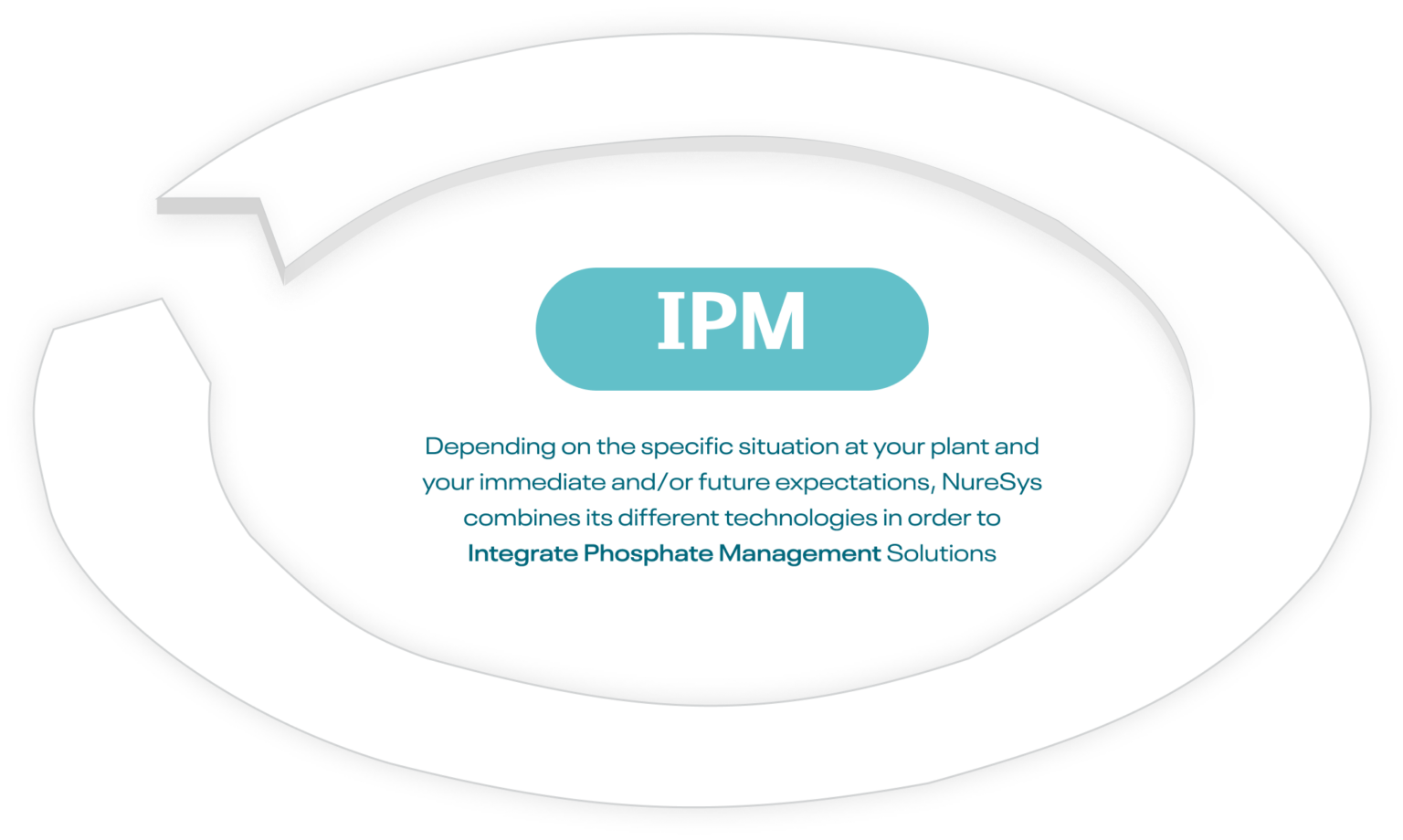
Integrated phosphate management (IPM) is a smart and proactive approach towards P-related problem solving within a wastewater treatment system. IPM helps to investigate and channel soluble P flows in a strategic way to decrease uncontrolled P precipitation.
Post Digestion
Reduction of struvite formation
Massive accumulation of uncontrolled ! struvite formation in digestion/post- digestion reactors will reduce effective reactor volume or storage volume. This periodically results in complete shut- down of concerned reactor tanks and entails huge maintenance costs.
Dewatering
Reducing the internal P loop
Sludge liquour, in particular of BNR plants, does contain high levels of PO4- P. The nature of Bio-P sludge is such that during anaerobic digestion it releases a significant amount of the accumulated PO4-P removed from the main waterline. This might does result in an internal P loop which can extend up to 25 to 30% of the incoming P load. This negatively affects the performance and stability of the BIO-P process.
Thickening
Reduction of the internal P loop
Intermediate storage of waste activated BIO-P biosolids prior to thickening pre- digestion does release both PO4-P and Mg2+.
The obtained filtrate is thus rich in PO4- P can causes and internal P loop, negatively affecting the performance and stability of the BIO-P process. This flow also contains significant levels of Mg2+ which will reduce uncontrolled struvite formation in the digestion/post- digestion. In addition, scaling will be less prominent.
Digestion
Avoid struvite formation
Not controlling the PO4-P/Mg2+ release will result in significant struvite formation in the digestion/post-digestion and also cause scaling of piping, heat- exchangers and dewatering equipment.